

Automation & AI Integration
The repetitive work in your business is a system nobody has built yet.

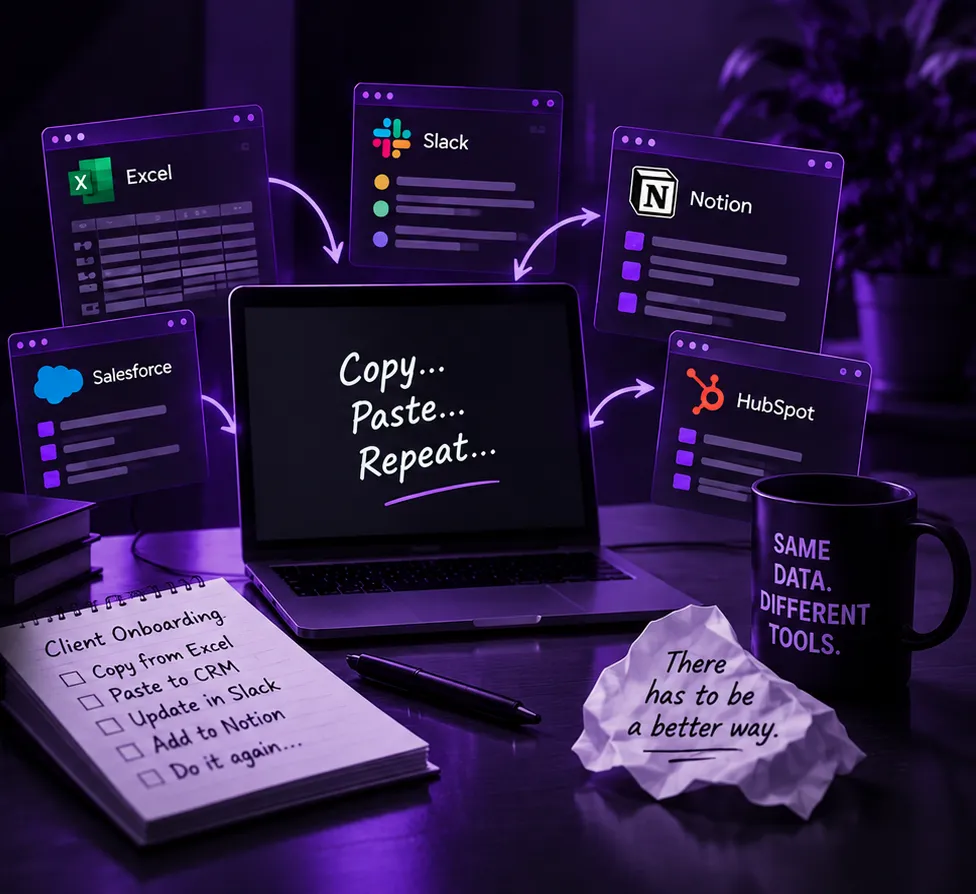
How Much Of Your Week Is Copy And Paste?
- The same information gets retyped into three different tools
- Onboarding a client is a checklist somebody has to remember
- The software you pay for does not talk to the other software you pay for
Most of it can be automated, and the parts that cannot usually need a small custom tool rather than another subscription. We work out which is which.
What Changes
Hours Back Every Week
The handoffs, reminders, and data entry that fill a day without producing anything run themselves instead.
Nothing Falls Through
A process that depends on someone remembering will eventually fail. A process that runs on a trigger does not.
Tools That Fit You
When no product does what you need, a small purpose-built tool beats bending your business around someone else's software.

How It Runs
Find It, Cost It, Then Decide Whether To Build It
Discovery is a call and a written map, usually inside a week. A typical build is two to four weeks depending on how many systems are involved. Custom apps run longer and are scoped individually.
Walk the work, free
A call going through how the job actually gets done now, not how the process document says it does. Every repeated manual step gets written down and costed in hours per month, which is what turns a vague sense of chaos into a list you can rank. You keep that map whether or not you build with us.
Decide what not to build
Plenty of problems are a settings change in software you already own, or a cheaper tool, or a habit. Recommending that costs us the project and saves you the money, and it is the fastest way to tell whether an automation consultant is reading your business or their invoice.
Build the one that pays for the engagement
Not the most interesting automation, the most expensive hour. Starting with the step that costs the most per month means the work funds itself before anyone has to trust a projection.
Hand it over documented
Built, tested, and written up so another developer could maintain it without calling us. Thirty days of adjustments after launch, because the first month of real use always finds something the walkthrough did not.
Maintain it, where it needs maintaining
A workflow automation mostly just runs. A custom application has dependencies and platforms moving underneath it, so those usually take a monthly arrangement priced to the app. We will tell you which one you are buying.
AI where it earns its place, and not where a plain automation does the job for less. Most of what makes a business feel chaotic is unconnected tools, not a missing model.
What We Build
Three Shapes This Work Takes
Some of this is connecting things that should already talk. Some of it is handing judgement to a model. Some of it is building the thing that does not exist yet.
Workflow Automation
- Client onboarding: intake, contracts, invoicing, kickoff
- Lead follow-up sequences by email and SMS
- Booking reminders and no-show recovery
- Connecting your CRM, forms, calendar, and billing
- n8n, Zapier, and Make, self-hosted where it saves money
- Reporting that assembles itself instead of being assembled
AI Integration
- Drafting: replies, proposals, first-pass copy
- Classifying: routing enquiries, tagging, triage
- Summarising: calls, threads, long documents
- Your own data, staying where you already keep it
- A human step wherever being wrong would be expensive
Custom Apps
- Internal dashboards for the numbers you actually check
- Client portals and information hubs
- Purpose-built web apps when off-the-shelf does not fit
- Stripe subscriptions and payment flows
- Documentation, so the system survives without us
Most of this sits on top of a site we built. See web design
Which of the three you need is usually clear within an hour of looking at how the work actually flows. That is what the first call is for.
Client Proof
Two Jobs That Stopped Existing
Automation work is hard to photograph. This is what it looks like in practice: a recurring job on the left, and what replaced it on the right.
Trip information at Miles & Memories
Before
Every trip meant sending itineraries, task lists, and booking links to as many as 300 travellers, across dozens of individually assembled emails. Anyone who lost the thread asked for it again, by hand.
After
Mandy builds one page per trip on her own site. Itinerary, tasks, and links live in one place, the page updates when the trip does, and the follow-up questions arrive at a URL instead of an inbox.
Sign-up to dispatched truck
Before
A roadside assistance startup with no product: every new customer would have meant taking payment manually, recording the plan somewhere, and phoning the details through to dispatch.
After
A web app with accounts, Stripe subscriptions, and a live integration into the dispatch system. A customer signs up, is billed, and is in the queue that sends the truck, without anyone touching it.
Josh took my idea and turned it into a real product: the brand, the app, the payment system, everything. He made building a startup feel manageable.
Abel LaekeFounder, NewFlower Roadside Josh is a rare combination for a software engineer: he is both a people person and a highly competent, knowledgeable tech guru. He is easy to communicate with, kind, and knows business, branding, and software engineering inside and out.
Amanda HainerClient


Describe the part of your week you would pay to stop doing. Most first calls surface two or three automations worth more than the build would cost.
How This Is Priced
Every One Of These Has Been Different
There is no package here and no audit fee. The discovery call and the proposal are free, because until we have looked at how your work actually flows, any number either of us names is a guess.
Workflow Automation
Connecting the tools you already pay for, so the handoffs run themselves.
Quoted to the job
Custom
What moves the price:
- How many systems have to talk to each other
- Whether those tools have real APIs or need working around
- How much of the logic is rules and how much is judgement
- Whether it runs on your subscriptions or self-hosted
AI Integration
Putting a model where it earns its place, and saying so when a plain automation does the job for less.
Quoted to the job
Custom
What moves the price:
- Whether it drafts, classifies, summarises, or decides
- How much of your own data it needs to see, and where that lives
- What has to happen when it gets something wrong
- Whether it runs on an API you rent or a model you host
Custom Apps
When the tool you need does not exist yet. Accounts, data, payments, logic.
Quoted to the job
Custom
What moves the price:
- Whether people log in and see different things
- What has to persist, and who is allowed to see it
- Payments, and whether they recur
- Maintenance, which most custom apps want monthly
Bring the task you dread most. The first call is about whether it can be automated at all and roughly what that would take, and you get that answer whether or not you go on to build it with us.
Why Us
Someone Who Reads The Business, Not Just The Stack
Engineering And Operations
Before this studio, Josh ran bar and restaurant operations. Knowing which processes actually matter is half the job, and it is the half most automation consultants skip.
We Say When Not To Build
Plenty of problems are a settings change or a cheaper tool. Recommending that costs us the project and saves you the money, which is the point.
You Own It
Self-hosted where it saves money, documented so another developer can pick it up. Nothing is locked to us.
Automation & AI Integration FAQ
What is workflow automation, in plain terms?
How much does AI integration and workflow automation cost?
Do I need AI for this?
Which tools do you work with?
How long does an automation project take?
What happens if it breaks after you hand it over?
What Would You Do With The Time Back?
Book a free consultation. Bring the task you dread most and we will tell you honestly whether it can be automated, and roughly what that would take.